

Why is AI becoming central to mobile app penetration testing? A mobile app is no longer just code on a phone. It connects to APIs, cloud services, identity providers, third-party SDKs, and device features. Every connection creates another place where security can break down.
AI helps testers work through that complexity without turning every assessment into a manual sorting exercise. Depending on the setup, teams may use AI-assisted scanners, specialized analysis tools, or an AI pentest agent to review traffic, map endpoints, generate test ideas, group related findings, and point testers toward areas worth a closer look.
Some agentic tools can also carry out several testing steps toward a defined objective, but the final judgment still belongs to the pentester. A finding has to be verified, reproduced, and assessed in the context of the application before it means anything.
How AI changes mobile app penetration testing
AI works best as a force multiplier. It reduces repetitive analysis and gives security teams more time for access-control flaws, chained attacks, and business logic issues.
Mobile testing also needs a mobile-specific security baseline. OWASP MASVS covers storage, cryptography, authentication, network communication, platform interaction, code, resilience, and privacy. It connects these controls with MASWE weaknesses and practical MASTG tests and demos.
Key areas to test
Five areas deserve consistent attention:
- Authentication, sessions, and authorization.
- Local storage, secrets, backups, and cryptography.
- Network traffic, APIs, certificate validation, and server-side flaws.
- Deep links, WebViews, permissions, and inter-app communication.
- Code, dependencies, tampering, reverse engineering, and privacy.
AI can prioritize these checks by comparing code, requests, responses, and previous findings. It is less reliable when a weakness depends on hidden business rules or subtle relationships between user roles.
App architecture still matters
Native Android and iOS apps expose platform-specific risks. Hybrid and cross-platform apps add frameworks, bridges, and web content. Progressive web apps depend more on browser, API, caching, and service-worker security.
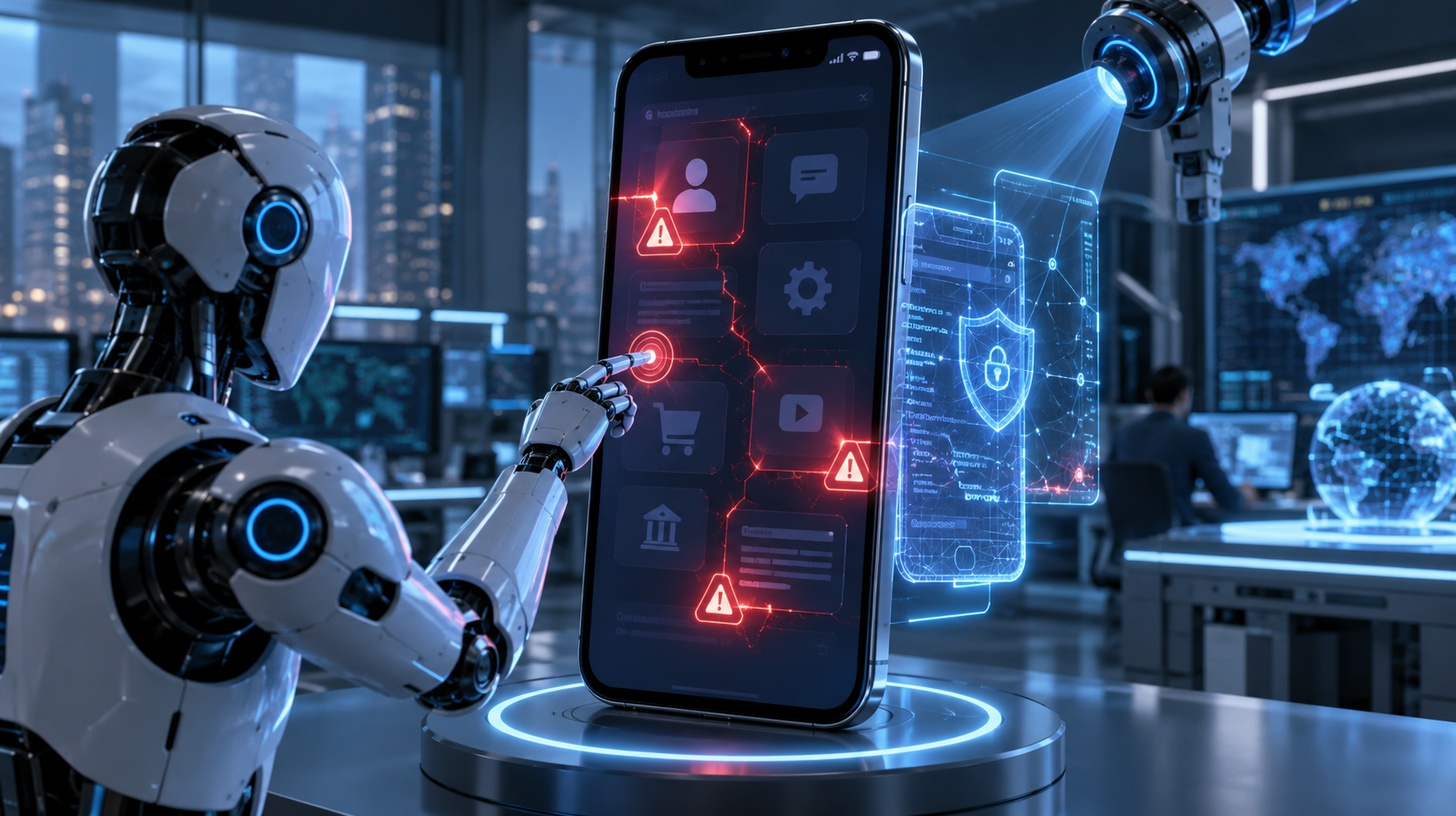
That is why one generic AI scanner is not enough. Testing should match the architecture, backend, data flows, and device capabilities.
An AI-assisted testing workflow
A solid engagement starts with scope and threat modeling. Testers identify sensitive data, roles, trust boundaries, APIs, SDKs, and likely abuse paths. Static analysis, dynamic testing, traffic inspection, and device-level checks follow.
AI can summarize code, explain requests, generate test variations, reduce repetitive triage, and help document evidence. Burp Suite now includes AI assistance and agentic testing for human-led pentesting. OWASP also lists Burp Suite, MobSF, Frida, and ZAP among tools used for mobile security testing.
Every serious finding still needs manual validation. AI can produce false positives, overstate severity, or miss flaws that require business context. Teams also need clear rules for sending source code, credentials, traffic, or customer data to AI services.
Compliance and reporting
Mobile penetration testing can support GDPR, PCI DSS, HIPAA, ISO/IEC 27001, SOC 2, and internal security requirements. It does not make an app compliant on its own.
AI can speed up reporting by drafting reproduction steps, grouping related weaknesses, mapping findings to controls, and suggesting remediation. A security professional should review the final report and risk rating.
AI-assisted tools
Security teams can now use AI inside dedicated AppSec and pentest products. Checkmarx applies AI to vulnerability triage. Katalon offers AI-assisted mobile testing and self-healing, while Kobiton combines AI-driven workflows with testing on real mobile devices. These capabilities can improve coverage, but they do not replace security-focused tools or manual penetration testing.
The main benefit of AI
AI makes mobile app penetration testing faster and easier to scale. The bigger gain is better use of human attention.
The strongest model is human-led testing with AI assistance. Automation handles volume and repetition. Experienced testers handle judgment, creative attack paths, exploit validation, and business logic. That balance makes AI a practical part of mobile security rather than a replacement for the people responsible for it.